
One of the best clues to a stone floor’s condition might be hiding under the entry rug. Lift a corner and you may see the finish you remember, just inches from a hallway that looks dull even when it’s clean. Countertops, tile, and grout can tell similar stories. Here are five common questions about marks and wear that linger after routine cleaning, and how we address them at Stoneshine.
1. Why is there still a cloudy ring on my marble countertop?
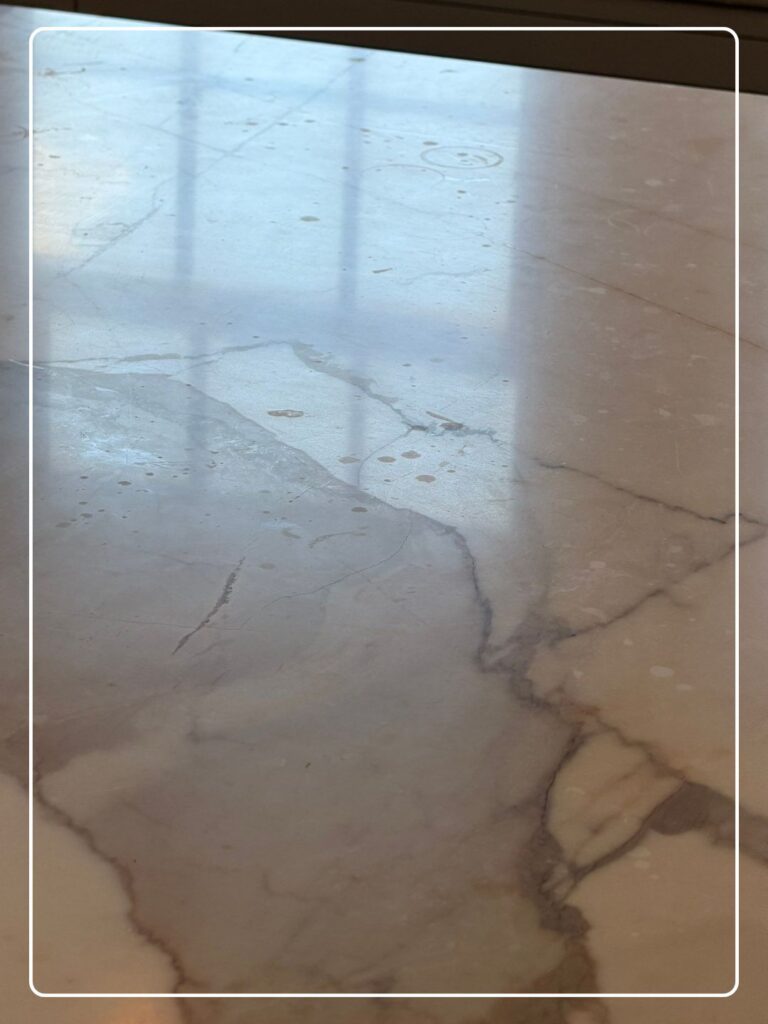 If a pale ring catches your eye when sunlight crosses the counter, it may be an etch mark. An acidic spill, such as lemon juice or wine, can change the texture of marble. The spot reflects light differently, which explains why it can disappear from one angle and stand out from another.
We examine the mark and the surrounding stone, then hone or polish the area to blend it back into the countertop. Whether your marble has a high shine or a soft matte finish, the goal is the same: you should be able to look across the counter without that one ring catching your eye.
2. Can anything be done about a dark spot that won’t fade?
A dark patch beside the cooktop, especially where a bottle of olive oil usually sits, may be a sign that oil has soaked into the stone. Once a spill settles below the surface, the spot can linger long after the counter feels clean.
We identify the stone, assess what may have caused the stain, and choose a treatment suited to both. We’ll explain how much improvement to expect and whether a penetrating sealer could give you more time to catch future spills.
3. Why does the middle of my stone floor look dull when the edges still shine?
Where the dullness appears can tell us a lot. If it follows the path from the front door to the kitchen, years of foot traffic and fine grit may have worn down the finish. The edges of the same floor can still look almost new because they see fewer footsteps.
We check for buildup and fine scratches. If residue is clouding the surface, a professional deep cleaning may be enough. If the finish has worn down, we can hone the stone to smooth the scratches and restore an even sheen across the floor.
4. Does a chip or crack near the sink mean the countertop needs replacing?
A small chip along a sink edge can often be repaired in place. We assess the damage, fill the missing area, and shape and finish the repair to follow the countertop’s original edge.
A crack calls for a closer look, especially if it’s getting longer. In some granite countertops, a metal support near the sink can rust and expand beneath the stone. Finding the cause helps us recommend a repair that addresses both the visible crack and the condition behind it.
5. Why does my grout still look gray when the tile looks clean?
Tile and grout can age differently. Soil can settle in recessed grout lines, and soap residue can build up in shower joints. Over time, those narrow lines can make a whole room look dingy even when the tile itself looks bright.
We deep-clean the tile and grout, then assess the joints. If the grout is sound but the color remains uneven, color sealing can restore a consistent shade. If sections are cracked or crumbling, we can repair those areas and recommend sealing where it will help with upkeep.
When should you have your stone evaluated?
A periodic evaluation gives us a chance to check the integrity of countertop edges and grout joints, catch early wear, and identify surfaces that could benefit from sealing. We’ll walk you through what needs attention now, what to keep an eye on, and how often a checkup makes sense for your space.
If your stone still looks beautiful, we can help you keep it that way. If a stain, chip, or worn patch is already bothering you, we can assess it and explain your repair options. Call or text Stoneshine at (877) 291-6093 for service in New York, New Jersey, or Connecticut, or request an evaluation online.