
When we’re called in to evaluate marble, the pattern is usually obvious within a few minutes.
In Manhattan and nearby areas especially, you’ll often see it right away:
- dull rings around sinks and vanities
- darkened areas where water sits regularly
- light etching in the spots that get used every day (& water stains)
- a general loss of clarity that makes the surface look tired
People often point to the water stains first—and they’re not wrong.
But those are just one piece of a bigger issue.
Because what you’re really seeing is a combination of stone etching, staining, surface wear, and breakdown of the finish.
And almost every time, we hear the same thing:
“We had it sealed.”
The Real Issue Isn’t Sealing—It’s the Strategy Behind It
Marble sealing didn’t fail.
The strategy did.
Most surfaces we’re asked to fix weren’t protected incorrectly—they were protected with the wrong system for how they’re actually used.
Marble doesn’t have just one vulnerability:
- it absorbs liquids
- it reacts to acids
- it wears down with repeated use
And no single protection method solves all three.
But in practice, that’s exactly how it’s treated.
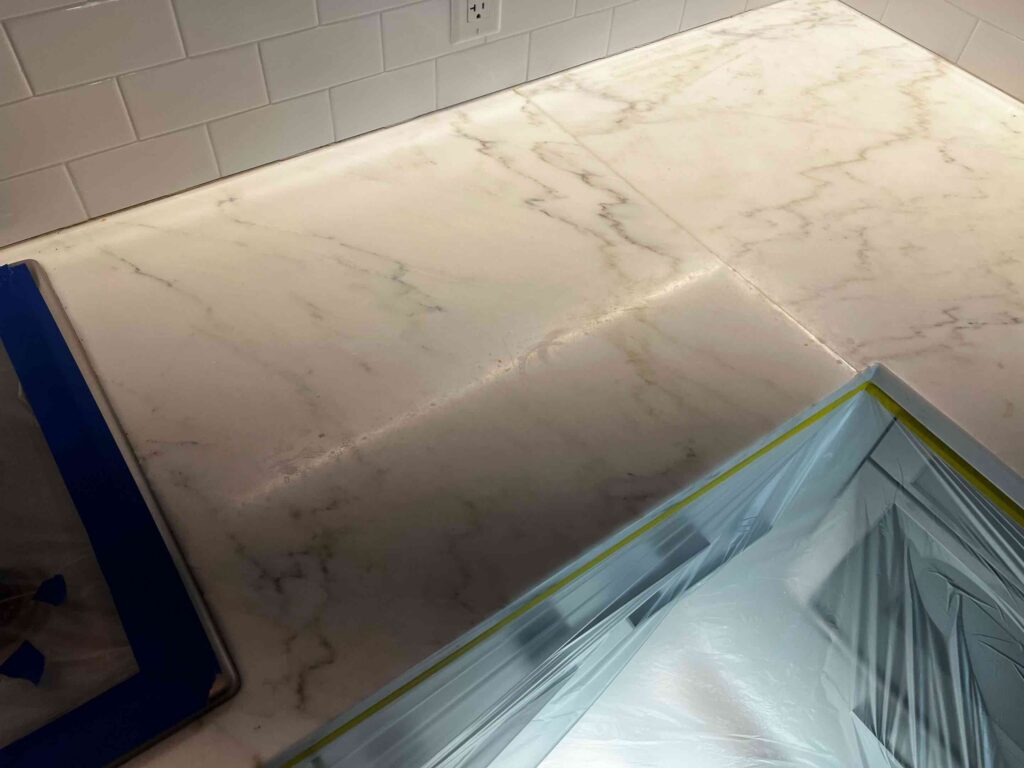
What’s Actually Happening to the Surface
Take a typical kitchen or bathroom in the Tri-State:
- Water and daily use slowly darken areas over time
- Cleaners, soap, and common household products create light etching
- Repeated contact in the same spots leads to uneven wear
- The original finish starts to lose depth and clarity
These issues don’t show up all at once.
They build gradually—until the surface no longer looks the way it should.
What Sealing Actually Does (and What It Doesn’t)
Traditional penetrating sealers are often the default solution.
They’re designed to:
- slow down liquid absorption
- reduce staining from water and oils
- provide temporary protection that needs to be maintained
They are not designed to:
- prevent etching
- stop surface wear
- preserve a polished finish under heavy use
And just as important—
they require regular reapplication.
So when a surface is sealed and still shows damage, the issue usually isn’t failure.
It’s expectation.
Why the Same Solution Keeps Getting Used
Because it’s simple.
“Seal it” is familiar, easy to recommend, and in some cases, it works.
In lower-use environments, sealing can be enough.
But most marble today isn’t living in low-use environments—especially in places like New York, New Jersey, and Connecticut.
That’s where the limitations show up.
Different Types of Marble Protection (And Where They Fit)
Once you step back from the idea that sealing is the only option, the choices become clearer:
- Penetrating (Impregnating) Sealers
- Slow liquid absorption and help reduce staining
- Suitable for lower-use or controlled environments
- Require ongoing reapplication and do not prevent etching
- Topical Coatings
- Sit on the surface and create a temporary barrier
- Can alter the appearance or feel of the stone
- Wear unevenly and tend to break down over time
- Permanent / Anti-Etch Protection Systems (e.g., AntiEtch)
- Bond to the surface through a UV-cured process
- Protect against both staining and acid etching
- Designed for kitchens, bathrooms, and high-use environments
Most failures happen when a basic sealer is used in a space that needed something more durable.
Where Things Actually Go Wrong
The issues we see are consistent:
- Marble is sealed when it actually needs etch protection
- Protection is applied after the surface has already started to break down
- High-use areas are treated like low-use ones
- Maintenance expectations aren’t clearly understood
None of that is poor workmanship.
It’s the result of applying the wrong solution to the wrong situation.
Why Experience Still Matters
There’s more information available than ever—guides, videos, and even AI-generated recommendations.
Some of it is useful.
But most of it doesn’t account for how marble behaves in real environments.
A recommendation that works in one setting can fail completely in another.
After 35+ years in the field—and through ongoing involvement with MB Stone Care and MB Stone Pro—we’ve seen how different systems actually perform over time, not just how they’re supposed to work.
That perspective is what allows the right decisions to be made before problems start.
In Conclusion
Etching, staining, rings, and dullness don’t happen randomly.
They’re signals.
They tell you the surface wasn’t protected for how it’s actually being used.
And in most cases, the issue isn’t that something was done wrong.
It’s that the wrong solution was trusted to do a job it was never designed for.
Not sure what your marble actually needs?
Stoneshine will evaluate your stone, how it’s being used, and recommend the right protection—whether that’s sealing, antietch, or restoration.